
Modern electronics are getting smaller, lighter, and more complex. That shift has pushed traditional circuit designs to their limits. Enter flex PCBs, a solution that allows circuits to bend, fold, and fit into spaces rigid boards simply can’t handle. Whether you’re designing advanced electronics or just exploring how devices are built, understanding flex PCBs is becoming essential.
In this guide, we’ll break down:
- What a flex PCB is and how it’s constructed
- How flex circuits function under movement and stress
- The key advantages and limitations to consider
- Where flex PCBs are most commonly used
- How they compare to traditional rigid boards
Let’s start with the fundamentals.
What is a Flex PCB?
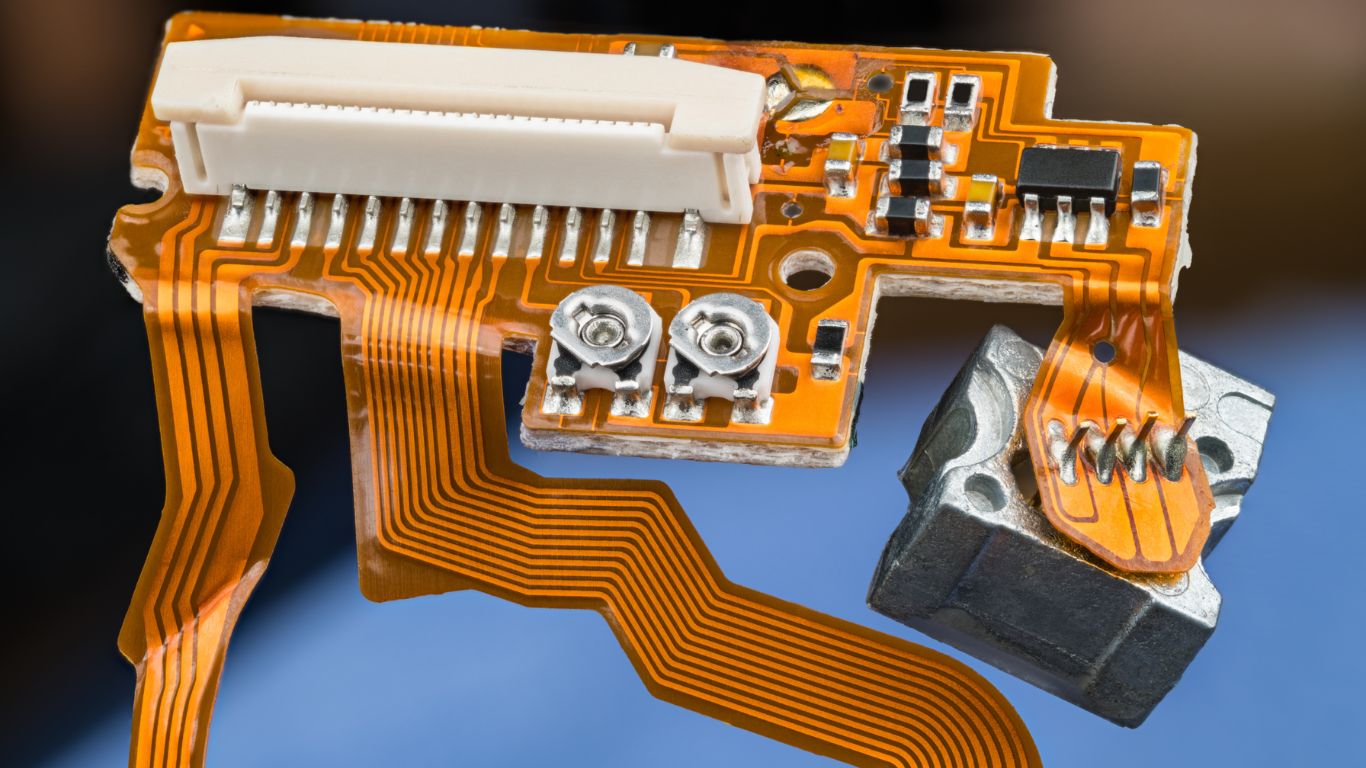
A flex PCB is a printed circuit board built on flexible materials that allow it to bend, twist, or fold while maintaining full electrical functionality. Instead of a rigid fiberglass base, it uses thin, durable substrates like polyimide to support conductive pathways.
At a structural level, a flex PCB works much like a traditional circuit board. The difference is in the materials and layering. To understand how a flex PCB is constructed, it helps to break down its core components:
- Flexible substrate (typically polyimide): The base layer that provides bendability and thermal stability
- Copper conductive layer: Thin copper traces that carry electrical signals across the circuit
- Coverlay or protective coating: A flexible insulating layer that protects traces from damage and environmental exposure
- Adhesive or adhesiveless bonding: Methods used to bond layers together, impacting durability and performance
Together, these layers form a circuit that behaves like a traditional PCB, but with the added advantage of mechanical flexibility.
How Do Flex PCBs Work?
Flex PCBs work by maintaining stable electrical connections through thin copper traces, even as the board bends or moves. Their flexible materials and carefully engineered layouts allow them to handle mechanical stress without breaking or degrading signal performance.
At the core, a flex PCB operates just like any other circuit. Electrical signals travel through copper pathways between components. The difference is that these pathways are designed to flex safely. Instead of resisting movement, the board distributes mechanical strain across its layers, preventing localized stress that could damage the circuit. Flex PCBs can be used in both static flex applications (bent once and held in place) and dynamic flex applications (repeated movement over time).
Designers must account for several critical factors:
- Bend radius: The minimum curvature the board can handle without stressing the copper traces
- Trace routing: Aligning traces perpendicular to the bend to reduce strain
- Layer stackup: Balancing materials and thickness to distribute stress evenly
- Reinforcement areas: Adding stiffeners where components or connectors need support
These design considerations ensure that flex PCBs can perform consistently, even in demanding environments.
What Are the Advantages of Flex PCBs?
Flex PCBs offer significant advantages over rigid boards, especially in applications where space, weight, and reliability are critical. Their ability to bend and conform opens up design possibilities that traditional PCBs simply cannot match.
Key benefits of flex PCBs include:
- Space savings: Flex circuits can fold or wrap into tight enclosures, making them ideal for compact electronics
- Weight reduction: Thin substrates and fewer components result in lighter assemblies, especially valuable in aerospace and portable devices
- Improved reliability: Fewer connectors and solder joints mean fewer opportunities for mechanical failure
- Design flexibility: Engineers can create 3D layouts that optimize internal space and component placement
- Reduced assembly complexity: Fewer interconnections simplify manufacturing and can improve consistency
Taken together, these advantages make flex PCBs a powerful solution for modern electronic design.
What Are the Limitations of Flex PCBs?
Flex PCBs offer powerful advantages, but they also come with tradeoffs that can impact cost, design complexity, and long-term durability. They are not always the right choice, especially for simpler or cost-sensitive applications.
One of the main challenges is that flex PCBs require more specialized design and manufacturing processes. Engineers must carefully account for bending stress, material behavior, and layer construction, which can increase development time. In addition, production often involves tighter tolerances and more complex fabrication steps compared to rigid boards, which can drive up initial costs.
These constraints don’t make flex PCBs inferior. They simply mean they must be used strategically.
Where Are Flex PCBs Used? (Common Applications)
Flex PCBs are used in applications where space constraints, movement, or reliability demands make rigid boards impractical. Their ability to conform to tight spaces and withstand vibration or repeated motion makes them essential across several high-performance industries.
In many cases, flex PCBs are not just a convenience. They are the only viable solution for achieving the desired form factor or durability. From compact consumer devices to mission-critical systems, their versatility enables designs that would otherwise require bulky wiring or multiple rigid boards.
Common applications of flex PCBs include:
- Consumer electronics: Smartphones, laptops, cameras, and wearables rely on flex circuits to fit more functionality into smaller spaces
- Medical devices: Imaging systems, implantables, and diagnostic tools benefit from lightweight, compact, and highly reliable circuitry
- Automotive systems: Used in dashboards, sensors, and control modules where vibration resistance and tight packaging are critical
- Aerospace and defense: Ideal for environments that demand weight savings, durability, and consistent performance under stress
These are the cases where flex PCBs deliver the most value.
Flex PCB vs. Rigid PCB: A Side-By-Side Comparison
Flex PCBs and rigid PCBs serve the same fundamental purpose, but they differ significantly in structure, performance, and ideal use cases. Choosing between them depends on your design constraints, budget, and reliability requirements.
At a high level, rigid PCBs use solid, inflexible substrates like fiberglass, making them stable and cost-effective for most standard electronics. Flex PCBs, on the other hand, are built for adaptability.
Here’s a quick comparison of the two:
| Feature | Flex PCB | Rigid PCB |
| Flexibility | Bendable, foldable | Fixed, inflexible |
| Space efficiency | Excellent for compact designs | Requires more space |
| Cost | Higher upfront cost | Lower initial cost |
| Durability | Strong under motion (if designed well) | Strong in static environments |
| Typical use cases | Wearables, aerospace, medical | General electronics, consumer devices |
This comparison makes one thing clear: neither is universally better. The right choice depends on the demands of your specific application.
Imagineering Expertise: What is a Flex PCB and Why It Matters
Flex PCBs offer a powerful way to design smaller, more reliable, and more adaptable electronic systems. From their flexible construction to their real-world applications, they give engineers new ways to solve complex design challenges that rigid boards can’t always address.
Understanding when and how to use a flex PCB can make a meaningful difference in performance, durability, and overall product design. That’s where experience matters.
If you’re exploring flex PCB solutions, working with a manufacturing partner that understands both design intent and production realities can save time and reduce risk.Imagineering brings that expertise to the table, helping you turn flexible concepts into reliable, real-world results.
Quick Summary
A flex PCB is a flexible printed circuit board designed to bend, fold, or twist while maintaining reliable electrical performance. This guide explains how flex PCBs work, their advantages and limitations, and where they are most commonly used. It also compares flex and rigid PCBs to help you determine the right solution for your application.
Flex PCB FAQs
Q1: What is a flex PCB used for?
Flex PCBs are used in applications that require compact design, movement, or high reliability, such as consumer electronics, medical devices, and aerospace systems.
Q2: Are flex PCBs more expensive than rigid PCBs?
Yes, flex PCBs typically have higher upfront costs due to materials and manufacturing complexity, but they can reduce overall system costs by simplifying assembly.
Q3: How durable are flex PCBs?
Flex PCBs are highly durable when properly designed, especially in dynamic environments, but excessive bending or poor design can lead to failure over time.