
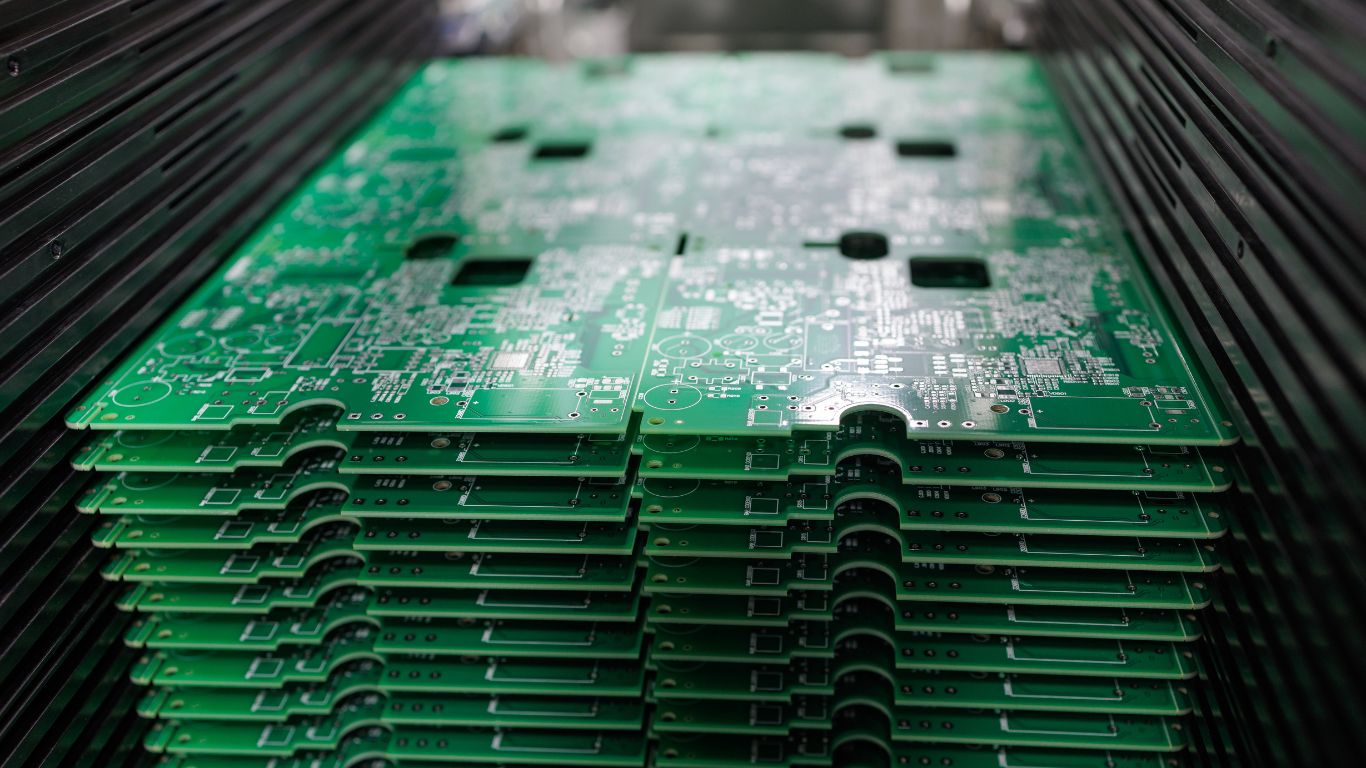
From smartphones and vehicles to industrial machinery and medical devices, modern technology runs on one essential component: the printed circuit board. These compact, layered platforms quietly power and connect the systems we rely on every day, making complex electronics possible at scale.
In this guide, we’ll break down everything you need to know about printed circuit boards, including:
- What a printed circuit board is
- What printed circuit boards are used for
- The different types of PCBs
- How PCBs are manufactured
- Why they’re essential to modern electronics
Let’s start with the fundamentals and define exactly what a printed circuit board is.
What Is a Printed Circuit Board (PCB)?
A printed circuit board (PCB) is a layered platform that mechanically supports and electrically connects electronic components using etched copper pathways. In simple terms, it replaces bulky wiring with a compact, reliable network that powers and controls modern electronics.
PCBs are built from a non-conductive substrate, typically fiberglass or engineered materials, with thin layers of copper laminated on top. These copper layers are etched into precise patterns that act as “roads” for electrical signals. Components like microchips, resistors, and connectors are mounted directly onto the board, creating a complete and functional circuit in a tightly controlled space.
To understand how a PCB works, it helps to break down its key elements:
- Substrate: The insulating base that gives the board structure
- Copper layers: Conductive pathways that carry signals and power
- Vias: Small holes that connect different layers electrically
- Solder mask: Protective coating that prevents short circuits
- Silkscreen: Printed labels for identification and assembly
Together, these elements form a durable, scalable system that enables everything from simple devices to highly complex electronics. This structure is what allows PCBs to serve as the foundation for nearly every modern electronic application, which we’ll explore next.
What Is a Printed Circuit Board Used For?
Printed circuit boards are used to connect components, distribute power, and enable functionality in nearly every electronic device. If a product has electronics, there is almost certainly a PCB inside making it work.
At a high level, a PCB acts as both the nervous system and structural backbone of a device. It routes signals between components, ensures consistent power delivery, and keeps everything organized in a compact footprint. Without PCBs, modern electronics would be larger, less reliable, and far more difficult to manufacture at scale.
To see how widespread their use is, consider the industries that rely on them:
- Consumer electronics: Smartphones, laptops, gaming systems, and appliances
- Automotive systems: Engine control units (ECUs), infotainment, EV battery management
- Industrial equipment: Automation systems, robotics, and power control units
- Medical devices: Imaging systems, monitoring equipment, diagnostic tools
- Telecommunications: Routers, servers, and 5G infrastructure
Each of these applications demands different levels of performance, durability, and complexity. For example, a smartphone PCB prioritizes miniaturization and density, while an industrial PCB must handle heat, vibration, and long-term reliability.
What Are the Main Types of Printed Circuit Boards?
Printed circuit boards come in several types, each designed to meet specific performance, space, and durability requirements. The right PCB type depends on how complex the device is and the environment it needs to operate in.
At a structural level, PCBs are often categorized by how many layers they use and how they’re built:
- Single-sided PCBs: One layer of copper; simple, low-cost applications
- Double-sided PCBs: Copper on both sides; more routing flexibility
- Multilayer PCBs: Multiple stacked layers; high-density, complex electronics
Beyond structure, form factor plays a major role in how a PCB is used:
- Rigid PCBs: Standard, non-flexible boards used in most electronics
- Flexible (flex) PCBs: Bendable circuits for compact or dynamic designs
- Rigid-flex PCBs: Hybrid designs that combine stability and flexibility
For more advanced applications, specialized boards are used:
- HDI (High-Density Interconnect): Extremely compact, high-performance designs
- Metal-core PCBs: Improved heat dissipation for power and LED applications
Each type is built to solve a specific engineering challenge, whether that’s saving space, improving performance, or managing heat. Understanding these differences makes it easier to see how PCBs are tailored to their applications, which leads naturally into how they’re actually manufactured.
How Are Printed Circuit Boards Made?
Printed circuit boards are made through a precise, multi-step manufacturing process that transforms raw materials into highly reliable electronic platforms. Each step is tightly controlled to ensure performance, consistency, and long-term durability.
At a high level, PCB fabrication follows a repeatable sequence of design transfer, material processing, and finishing:
- Design and layout: Engineers create the circuit using CAD software, defining trace paths and layer structure
- Imaging and etching: Copper layers are patterned by removing unwanted material, leaving only the intended circuitry
- Layer stacking and lamination: Multiple layers are bonded together under heat and pressure to form a solid board
- Drilling and plating: Holes are drilled and plated with copper to connect different layers electrically
- Solder mask and finishing: Protective coatings and surface finishes are applied to prepare the board for assembly
Each of these steps builds on the last, turning a digital design into a physical, functional component. The level of precision required is what allows PCBs to perform reliably in everything from consumer devices to mission-critical systems.
Why Are Printed Circuit Boards Essential in Modern Electronics?
Printed circuit boards are essential because they make modern electronics smaller, more reliable, and scalable to mass production. Without PCBs, most of the devices we rely on daily would be impractical to build or maintain.
At a fundamental level, PCBs replace fragile, error-prone wiring with a stable, repeatable system. This allows manufacturers to produce complex electronics at scale while maintaining consistent performance. It also enables engineers to design increasingly compact and powerful devices without sacrificing reliability.
The value of PCBs becomes even clearer when you look at their core advantages:
- Reliability: Fixed pathways reduce connection failures and human error
- Scalability: Designs can be replicated quickly and cost-effectively
- Compact design: High-density layouts support miniaturization
- Performance consistency: Controlled layouts improve signal integrity
These benefits are what make PCBs the foundation of everything from smartphones to industrial systems. As technology continues to evolve, their role will only become more critical, especially as devices demand more power, speed, and efficiency.
Imagineering’s Printed Circuit Board Solutions for Today’s Most Demanding Applications
Printed circuit boards are the foundation of modern electronics, enabling everything from simple devices to highly advanced systems. Understanding what a printed circuit board is, what it’s used for, and how it’s designed and manufactured gives you a clearer picture of what goes into reliable, high-performance electronics.
Whether you’re developing a new product or refining an existing design, the quality of your PCB partner matters. If you’re looking for a team that understands the technical demands behind every printed circuit board and can support you from prototype to production, Imagineering is built to help you move forward with confidence.
Quick Summary
A printed circuit board (PCB) is the foundation of modern electronics, enabling components to connect, communicate, and function efficiently. This guide explains what printed circuit boards are, what they’re used for, the different types available, and how they’re manufactured. It also highlights why PCBs are essential for reliable, scalable electronic design across industries.
Printed Circuit Board FAQS
Q1: What is a printed circuit board used for?
A printed circuit board is used to connect and support electronic components while enabling signal and power distribution. It serves as the backbone of nearly all electronic devices.
Q2: What are the main types of printed circuit boards?
The main types include single-sided, double-sided, multilayer, rigid, flexible, and rigid-flex PCBs. Each type is designed for specific performance, space, and durability requirements.
Q3: Why are printed circuit boards important?
Printed circuit boards improve reliability, reduce size, and allow for scalable manufacturing. They make modern electronics practical, efficient, and cost-effective to produce.